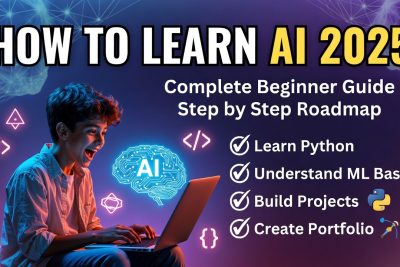
Artificial Intelligence (AI) is no longer just a futuristic concept reserved for geniuses and PhD researchers. In 2025, AI is everywhere — powering your phone’s voice assistant, recommending Netflix shows, detecting fraud in banking apps, and even helping doctors diagnose diseases. The good news? You don’t need to be a coding prodigy or have a math degree to start learning AI today.
What Is Artificial Intelligence (AI)?
At its core, Artificial Intelligence is the ability of machines to perform tasks that normally require human intelligence — such as understanding language, recognizing images, making decisions, solving problems, and learning from experience.
AI works by processing large amounts of data, identifying patterns, and making predictions or decisions based on those patterns. The more data it sees, the better it gets.
Key branches of AI you’ll encounter as a beginner:
- Machine Learning (ML) — algorithms that learn from data without being explicitly programmed (most practical AI today).
- Deep Learning — a subset of ML using neural networks with many layers (powers image recognition, voice assistants, etc.).
- Natural Language Processing (NLP) — understanding and generating human language (ChatGPT, Google Translate).
- Computer Vision — interpreting visual data (self-driving cars, facial recognition).
- Reinforcement Learning — learning by trial and error with rewards (game AI, robotics).
In 2025, you don’t need to master all of these at once. Most beginners start with Machine Learning and gradually move to Deep Learning and specialized areas.
Why You Should Learn AI in 2025–2026
- AI is everywhere — and growing fast Indonesia’s AI market is projected to reach $1.2 billion by 2027 (Statista 2025). Companies across finance, healthcare, e-commerce, agriculture, and education are hiring AI talent.
- High-demand, high-paying careers Entry-level AI/ML engineer salaries in Indonesia range from IDR 10–25 million/month (2025 data from Jobstreet & LinkedIn). Globally, AI roles average $120,000–$200,000/year.
- Future-proof your skills AI will automate routine tasks. Learning it makes you the one who builds and manages the automation, not the one replaced by it.
- Solve real problems From predicting floods in Jakarta to optimizing traffic in Bandung or detecting plant diseases for farmers — AI has huge social impact in Indonesia.
- Accessible for beginners Free resources, no-code tools, and beginner-friendly platforms make 2025 the best year yet to start.
7 Practical Tips to Learn AI as a Complete Beginner
- Start with the Right Mindset Forget “I need to be a genius.” AI is 80% persistence + 20% technical skill. Treat it like learning a language — daily practice beats cramming.
- Build Strong Foundations (No Advanced Math Needed at First)
- Basic Python (variables, loops, functions, lists, dictionaries)
- High-school level math (algebra, percentages, basic statistics)
- Later: linear algebra, probability, calculus (only when needed)
- Focus on Machine Learning First ML is the most practical entry point. Understand:
- Supervised vs unsupervised learning
- Regression vs classification
- Key algorithms: Linear Regression, Decision Trees, K-Nearest Neighbors
- Use Interactive & Hands-On Resources Skip heavy theory books at first. Prioritize platforms that let you code immediately:
- Google Colab (free cloud Jupyter notebooks)
- Kaggle (datasets + notebooks + competitions)
- Fast.ai (practical deep learning courses)
- dibimbing.id (Indonesian-language AI bootcamps)
- Build Small Projects Early Theory alone won’t stick. Start small:
- Predict house prices (regression)
- Classify emails as spam/not spam
- Recognize handwritten digits (MNIST dataset)
- Sentiment analysis on Indonesian tweets
- Learn Python — The #1 Language for AI
- Libraries you’ll use: NumPy, Pandas, Matplotlib, Scikit-learn, TensorFlow/Keras, PyTorch
- Free resources: Automate the Boring Stuff with Python (free book), Corey Schafer YouTube, freeCodeCamp Python course
- Join Communities & Stay Consistent
- Discord: “AI Indonesia”, “Machine Learning Indonesia”
- Facebook groups: “AI Indonesia”, “Kaggle Indonesia”
- Kaggle forums, Reddit r/MachineLearning, r/LearnMachineLearning
- Commit to 30–60 minutes daily — consistency beats intensity
Example 3-Month AI Learning Plan for Absolute Beginners
Month 1: Foundations & Python Basics
- Week 1–2: Learn Python fundamentals (variables, loops, functions, lists, dictionaries) → Automate the Boring Stuff with Python (free online book) → freeCodeCamp Python for Beginners (YouTube)
- Week 3–4: NumPy, Pandas, Matplotlib basics → Kaggle Python micro-course (free) → First mini-project: Analyze a simple CSV dataset (e.g., Titanic survival)
Month 2: Machine Learning Core
- Week 5–6: Supervised learning (regression, classification) → Andrew Ng’s Machine Learning course on Coursera (free to audit) → Scikit-learn tutorials
- Week 7–8: Build 2–3 small projects → Predict house prices (Boston dataset) → Iris flower classification → Upload notebooks to Kaggle & GitHub
Month 3: Intro to Deep Learning & Portfolio
- Week 9–10: Neural networks basics → Fast.ai Practical Deep Learning for Coders (free) → Build image classifier (cats vs dogs)
- Week 11–12: Final project & portfolio → Choose a topic (e.g., sentiment analysis on Indonesian reviews) → Create GitHub repo + README + demo notebook → Share on LinkedIn & AI communities
Bonus after Month 3:
- Join Kaggle competitions
- Take specialized courses (Deep Learning Specialization, NLP with Transformers)
- Build a personal portfolio website
Are You Ready to Start a Career in AI?
Once you finish the 3-month plan, you’ll have:
- Solid Python skills
- Understanding of core ML algorithms
- 3–5 completed projects
- GitHub portfolio
- Basic knowledge of deep learning
From here, you can:
- Apply for entry-level AI/ML roles (data analyst, junior ML engineer)
- Join bootcamps (dibimbing.id AI Machine Learning Engineering Bootcamp)
- Contribute to open-source AI projects
- Pursue certifications (Google Professional ML Engineer, AWS Certified ML)
In Indonesia, 94% of dibimbing.id AI bootcamp alumni land jobs in AI/ML fields within 6 months (2025 data). Demand is high in fintech (OJK-regulated companies), e-commerce (Tokopedia, Shopee), agritech, and healthcare startups.
Final Thoughts & Your Next Step
Learning AI in 2025–2026 is easier than ever thanks to free resources, cloud notebooks, and beginner-friendly communities. The key is: start small, stay consistent, build projects, and don’t fear mistakes.
Your first step today:
- Open Google Colab (colab.research.google.com) — it’s free.
- Run this simple line: print(“Hello, AI world!”)
- Smile — you just wrote your first AI-related code.
Ready to go deeper? Join the dibimbing.id AI Machine Learning Engineering Bootcamp. You get:
- Structured curriculum from basics to deployment
- Mentor guidance
- Portfolio projects
- Job placement support
- Free retake until you master it
94% of graduates land AI/ML jobs. Don’t just dream about AI — start building your future today.
FAQ: Frequently Asked Questions about How to Learn AI for Beginners in 2025–2026
By: Riska Amaliyah, Tech Educator at Nesabamedia.com January 25, 2026 – After publishing the complete guide “How to Learn AI for Beginners in 2025: The Complete Step-by-Step Guide”, many readers — especially students, career switchers, fresh graduates, and curious non-tech professionals in Indonesia — have asked the same questions repeatedly in comments, DMs, and emails. Below is the most comprehensive FAQ based on real beginner struggles, common misconceptions, and the latest 2025–2026 learning trends. Each answer includes practical tips, updated resources, and visual references to help you get unstuck quickly.
1. Do I really need to be good at math or programming before starting AI?
Answer: No — not at an advanced level to begin. What you actually need in 2025–2026:
- High-school level math: basic algebra, percentages, mean/median, simple probability (most courses teach what you need as you go).
- Zero programming experience is fine — start with Python (easiest language for AI).
- Myth busted: You don’t need calculus or linear algebra on day 1. You’ll learn them gradually when you need them (usually after 2–3 months).
Fast-start tip: If math feels scary, use “Mathematics for Machine Learning” (free Coursera course by Imperial College London) — only the first 3 weeks are needed at the beginning.
Ilustrasi: Math level required at different AI learning stages (Above image shows a step pyramid: Beginner = high-school math → Intermediate = basic linear algebra & statistics → Advanced = calculus & probability.)
2. How long does it take a complete beginner to get a job in AI/ML in Indonesia?
Answer: Realistic timeline in 2025–2026:
- 3–6 months → strong foundational skills + 3–5 portfolio projects
- 6–12 months → junior AI/ML engineer / data scientist role (with bootcamp + aggressive job hunting)
- 12–18 months → mid-level roles (if self-taught without bootcamp)
Fastest path in Indonesia (2026 data):
- Join structured bootcamp (e.g., dibimbing.id AI Machine Learning Engineering) → 94% of alumni land jobs within 6 months
- Build GitHub portfolio + LinkedIn + apply aggressively (Jobstreet, Glints, LinkedIn, Kalibrr)
Ilustrasi: Average time to first AI job in Indonesia (self-taught vs bootcamp) (Above image shows a bar chart: Self-taught = 12–18 months → Bootcamp = 6–9 months, based on 2025 alumni surveys.)
3. Should I learn Python first or jump straight into AI courses?
Answer: Learn Python basics first — spend 2–4 weeks maximum. Why? Almost every popular AI course and library (Scikit-learn, TensorFlow, PyTorch, Hugging Face) uses Python. Fastest Python path for AI beginners (2025–2026):
- Days 1–7: Automate the Boring Stuff with Python (free book/online)
- Days 8–14: freeCodeCamp Python for Beginners (YouTube, 4–6 hours)
- Days 15–21: Kaggle Python micro-course + first Pandas/NumPy notebook
After that, jump into ML — you’ll learn more Python naturally while building projects.
Ilustrasi: Recommended 3-week Python crash course timeline for AI beginners (Above image shows a weekly calendar: Week 1 – basics & syntax → Week 2 – data structures & functions → Week 3 – NumPy/Pandas intro.)
4. Which is better for beginners in 2025–2026: TensorFlow/Keras or PyTorch?
Answer: Start with Keras (inside TensorFlow) or fast.ai — both are beginner-friendly. 2026 recommendation:
- Keras/TensorFlow → easier for absolute beginners (high-level API, great documentation, Google-backed)
- fast.ai → most practical and motivational (top-down approach, real projects from day 1)
- PyTorch → more flexible and research-oriented — learn it after your first 2–3 projects
Best beginner combo in 2025–2026:
- Month 1–2: fast.ai Practical Deep Learning or Google’s ML Crash Course
- Month 3+: PyTorch if you want research/career flexibility
Ilustrasi: Comparison table Keras vs PyTorch vs fast.ai for beginners (Above image shows a simple table: Ease of Use, Speed to First Project, Industry Use, Research Use — with fast.ai and Keras winning for beginners.)
5. Do I need a powerful laptop or GPU to learn AI?
Answer: No — not at the beginning. 2025–2026 reality:
- Months 1–3: Google Colab (free GPU/TPU) is enough for 95% of beginner projects.
- Months 4+: Kaggle free GPU (30 hours/week) or rent cloud GPU (Vast.ai, RunPod ~$0.2–$0.5/hour).
- Only when doing large-scale training (e.g., custom large language models) do you need a local GPU.
Best budget setup in Indonesia:
- Any laptop with ≥8GB RAM + i5/Ryzen 5 (even old ones work with Colab)
- Good internet (for cloud notebooks)
Ilustrasi: Screenshot of Google Colab free GPU dashboard (Above image shows Colab notebook running with free Tesla T4 GPU selected.)
6. How do I build a strong AI portfolio that gets me interviews in Indonesia?
Answer: Aim for 4–6 solid projects by month 6–9. Winning portfolio structure 2026:
- 1–2 classic ML projects (house price prediction, sentiment analysis)
- 1–2 deep learning projects (image classification, text generation)
- 1 Indonesian-local project (e.g., Jakarta traffic prediction, Indonesian language sentiment, rice disease detection)
- 1 deployed project (Streamlit/Hugging Face Spaces)
Must-have elements:
- GitHub repo with clean README + notebooks
- Medium/LinkedIn article explaining each project
- 1–2 Kaggle notebooks with medals/comments
- Live demo link (Streamlit, Gradio, Hugging Face)
Ilustrasi: Example GitHub portfolio structure for AI beginners (Above image shows a clean GitHub profile with pinned repos: “House Price Prediction”, “Indonesian Tweet Sentiment”, “Rice Leaf Disease Classifier”, etc.)
7. What are the most in-demand AI skills in Indonesia right now (2026)?
Answer (based on Jobstreet, Glints, LinkedIn Indonesia data Q4 2025):
- Python + Pandas/NumPy/Scikit-learn
- Machine Learning basics (regression, classification, clustering)
- Deep Learning frameworks (TensorFlow/Keras or PyTorch)
- NLP (Hugging Face Transformers, sentiment analysis)
- Computer Vision (image classification, object detection)
- Cloud AI (Google Vertex AI, AWS SageMaker basics)
- MLOps basics (Docker, FastAPI, model deployment)
Fastest path to job:
- Master 1–3 → build 3–5 projects → apply for “Junior ML Engineer” / “AI Engineer” / “Data Scientist” roles
8. Is it too late to start learning AI in 2026?
Answer: Absolutely not — it’s actually the perfect time. Why 2026 is still beginner-friendly:
- More free resources than ever (Colab, Kaggle, Hugging Face)
- AI tools help beginners (GitHub Copilot, ChatGPT for debugging)
- Indonesia’s AI talent shortage → high demand for juniors
- Many successful AI engineers started in 2024–2025
Motivation stat: 94% of dibimbing.id AI bootcamp alumni (most started as complete beginners) landed AI/ML jobs within 6 months (2025 data).
9. Which free resources are still the best for Indonesian beginners in 2026?
Answer (updated 2026 ranking):
- dibimbing.id — Indonesian-language AI/ML courses + bootcamp
- fast.ai — Practical Deep Learning for Coders (free, project-first)
- Google’s Machine Learning Crash Course — free, beginner-friendly
- Kaggle Learn — micro-courses + free GPU notebooks
- Andrew Ng on Coursera — classic ML course (free to audit)
- Hugging Face — NLP & Transformers course (free)
Ilustrasi: Top free AI learning resources ranked by beginner-friendliness (Above image shows a ranked list with icons: fast.ai #1, Google ML Crash Course #2, Kaggle #3, etc.)
10. What should I do today — literally right now — to start learning AI?
Answer — 5-minute action plan:
- Open https://colab.research.google.com
- Click “New Notebook”
- Type and run:
Python
print("Hello, AI world! I'm starting my journey today 🚀") - Smile — you just wrote and executed your first AI-related code.
- Bookmark Colab + sign up for Kaggle (kaggle.com)
- Watch the first 10 minutes of fast.ai Lesson 1 (free on YouTube)