Artificial Intelligence (AI) is one of the most transformative technologies of the 21st century. It refers to the ability of machines and computer systems to perform tasks that traditionally require human intelligence. These tasks include learning from data, recognizing patterns, understanding natural language, making decisions, and even generating creative content.
In recent years, AI has evolved from a theoretical concept into a practical technology that powers everyday applications—from voice assistants and recommendation engines to autonomous vehicles and medical diagnostics. The rapid advancement of AI is driven by three key factors: increased computing power, availability of large datasets, and the development of powerful AI frameworks and tools.
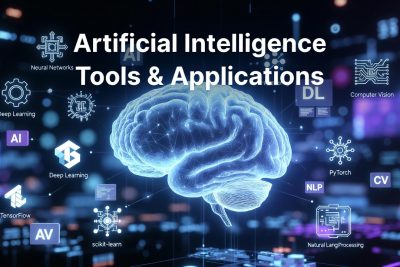
This article provides a comprehensive overview of Artificial Intelligence tools and frameworks as well as real-world applications of AI across multiple industries, helping readers understand both the technical foundation and practical impact of AI.
Understanding AI Frameworks and Libraries
AI frameworks and libraries are collections of pre-built tools, functions, and resources that simplify the process of developing, training, and deploying AI and machine learning models. Instead of building algorithms from scratch, developers can leverage these frameworks to accelerate development, improve accuracy, and scale AI solutions efficiently.
Below are some of the most widely used AI frameworks and libraries today.
1. PyTorch
PyTorch is an open-source deep learning framework developed by Facebook’s AI Research Lab. It is built on the Torch library and is known for its dynamic computation graph, which allows developers to modify model behavior during runtime.
Key Advantages of PyTorch
-
Dynamic and flexible computation graphs
-
Easy debugging and experimentation
-
Strong support for GPU acceleration
-
Widely adopted by researchers and academics
Common Use Cases
PyTorch is commonly used for:
-
Computer vision applications
-
Natural language processing (NLP)
-
Image recognition and object detection
-
Research and experimental AI models
Due to its flexibility, PyTorch has become a favorite framework in research environments and AI innovation labs.
2. Scikit-Learn
Scikit-Learn is a popular open-source machine learning library for Python. It is designed to be simple, efficient, and accessible, making it ideal for beginners and professionals alike.
Core Features
-
User-friendly API
-
Extensive documentation and tutorials
-
Built-in tools for data preprocessing
-
Strong integration with NumPy and Pandas
Typical Applications
Scikit-Learn is primarily used for:
-
Classification and regression tasks
-
Clustering and anomaly detection
-
Dimensionality reduction
-
Feature selection and model evaluation
While it is not designed for deep learning, Scikit-Learn excels in traditional machine learning workflows.
3. TensorFlow
TensorFlow is an open-source deep learning framework developed by Google. It is designed for scalability and performance, making it suitable for both research and production environments.
Strengths of TensorFlow
-
Highly scalable and production-ready
-
Supports distributed training
-
Extensive ecosystem and community support
-
Cross-platform deployment (web, mobile, cloud, edge devices)
Use Cases
TensorFlow is widely used for:
-
Image and speech recognition
-
Handwriting recognition
-
Sentiment analysis
-
Machine translation
-
Recommendation systems
TensorFlow’s flexibility makes it a top choice for enterprise-level AI applications.
4. Keras
Keras is a high-level neural network API that runs on top of TensorFlow and other backends. It is designed to make deep learning more accessible.
Why Developers Choose Keras
-
Easy to learn and use
-
Clean and intuitive syntax
-
Fast model prototyping
-
Ideal for beginners in AI
Common Applications
Keras is often used for:
-
Building and training neural networks
-
Rapid experimentation
-
Educational purposes
-
Deep learning projects with limited complexity
Keras significantly reduces the learning curve for deep learning development.
5. Microsoft Cognitive Toolkit (CNTK)
Microsoft Cognitive Toolkit, also known as CNTK, is an open-source deep learning framework developed by Microsoft. It is optimized for performance and scalability.
Key Capabilities
-
Efficient training of deep neural networks
-
Support for feedforward and recurrent networks
-
High performance on large datasets
Practical Uses
CNTK has been used in:
-
Speech recognition systems
-
Image recognition applications
-
Predictive analytics
-
Autonomous systems
Although less popular today, CNTK played an important role in enterprise AI development.
6. LangChain
LangChain is a modern AI framework specifically designed for applications powered by Large Language Models (LLMs). It enables developers to connect language models with external data sources, tools, and APIs.
Key Features
-
Chain-based execution of AI tasks
-
Integration with OpenAI and Hugging Face
-
Modular and extensible design
Popular Applications
LangChain is commonly used for:
-
AI chatbots
-
Document summarization
-
Question-answering systems
-
Workflow automation using LLMs
LangChain is especially valuable for building intelligent, context-aware AI applications.
7. Hugging Face
Hugging Face is an open-source platform that provides tools and pre-trained models for machine learning, especially in natural language processing.
Core Benefits
-
Access to thousands of pre-trained models
-
Transformers library for NLP tasks
-
Model sharing and collaboration
-
Reduced training time and resource consumption
Typical Use Cases
Hugging Face is widely used for:
-
Text classification
-
Language translation
-
Sentiment analysis
-
Speech recognition
It has become an industry standard for NLP development.
8. PyBrain
PyBrain is an open-source Python library designed for machine learning and neural network experimentation.
Key Features
-
Modular architecture
-
Pre-defined environments for testing algorithms
-
Easy integration with Python projects
Use Cases
PyBrain is mainly used for:
-
Research and experimentation
-
Training neural networks
-
Comparing machine learning algorithms
9. Theano
Theano is a Python library that allows developers to define, optimize, and evaluate mathematical expressions efficiently.
Strengths
-
GPU acceleration
-
Efficient numerical computation
-
Foundation for early deep learning frameworks
Although no longer actively developed, Theano laid the groundwork for modern AI frameworks.
10. Caffe
Caffe is a deep learning framework known for its speed and efficiency, particularly in image processing tasks.
Key Characteristics
-
High-performance model training
-
Strong focus on computer vision
-
Optimized for convolutional neural networks (CNNs)
Applications
Caffe is commonly used for:
-
Image classification
-
Object detection
-
Visual recognition systems
11. XGBoost
XGBoost (Extreme Gradient Boosting) is a powerful machine learning algorithm optimized for performance and scalability.
Why XGBoost Is Popular
-
High prediction accuracy
-
Fast training speed
-
Handles large datasets efficiently
Common Applications
XGBoost is widely used for:
-
Financial risk modeling
-
Customer churn prediction
-
Data science competitions
-
Business analytics
Real-World Applications of Artificial Intelligence
AI is not limited to research labs—it is actively transforming industries worldwide.
AI in Healthcare
AI in healthcare improves diagnosis, treatment, and patient care.
Key Applications
-
Medical image analysis
-
Drug discovery
-
Robotic surgery
-
Personalized treatment plans
AI systems can analyze X-rays, CT scans, and MRIs faster and often more accurately than humans.
AI in Finance
The financial sector uses AI to improve efficiency, security, and decision-making.
Applications Include
-
Credit scoring automation
-
Fraud detection
-
Market prediction
-
AI-powered chatbots
AI enables real-time analysis of massive financial datasets.
AI in the Automotive Industry
AI plays a critical role in modern vehicles.
Use Cases
-
Autonomous driving systems
-
Advanced driver-assistance systems (ADAS)
-
Quality inspection in manufacturing
Computer vision and machine learning enhance safety and performance.
AI in E-Commerce
AI helps businesses deliver personalized shopping experiences.
Common Uses
-
Product recommendation engines
-
Customer service chatbots
-
Inventory management
-
Dynamic pricing
AI increases customer satisfaction and sales efficiency.
AI in Agriculture
AI supports sustainable and efficient farming practices.
Applications
-
Crop health monitoring
-
Weather prediction
-
Pest and disease detection
-
Precision farming
Drones and sensors powered by AI enable real-time agricultural insights.
AI in Human Resources
AI streamlines HR processes and reduces bias.
Use Cases
-
Resume screening
-
Candidate matching
-
Employee performance analysis
-
Training recommendations
AI allows HR teams to focus on strategic decision-making.
AI in the Legal Industry
AI assists legal professionals in managing complex workloads.
Applications
-
Document review and analysis
-
Contract drafting
-
Legal research
-
Case prediction
AI reduces manual effort and improves accuracy.
AI in Gaming
AI enhances realism and engagement in games.
Examples
-
Intelligent non-player characters (NPCs)
-
Dynamic difficulty adjustment
-
Simulation-based training
AI creates adaptive and immersive gaming experiences.
AI in Education
AI enables personalized and data-driven learning.
Key Benefits
-
Adaptive learning platforms
-
Automated grading
-
Student performance analysis
-
Personalized study recommendations
AI helps educators tailor learning experiences to individual needs.
Artificial Intelligence has become a cornerstone of modern technology. From powerful frameworks like PyTorch, TensorFlow, LangChain, and Hugging Face to real-world applications across healthcare, finance, education, and beyond, AI continues to reshape how we live and work.
As AI tools become more accessible and powerful, understanding both the technical foundations and practical applications of AI is essential for developers, businesses, and learners alike. AI is no longer a future concept—it is a present-day reality driving innovation across the globe.
Frequently Asked Questions (FAQ)
1. What is Artificial Intelligence (AI)?
Artificial Intelligence is a branch of computer science that focuses on creating systems capable of performing tasks that normally require human intelligence, such as learning, reasoning, problem-solving, understanding language, and recognizing patterns.
2. Why is Artificial Intelligence important today?
AI is important because it increases efficiency, reduces human error, processes large volumes of data quickly, and enables automation across industries such as healthcare, finance, education, and manufacturing.
3. What is the difference between AI, Machine Learning, and Deep Learning?
AI is the broader concept of machines performing intelligent tasks. Machine Learning is a subset of AI that enables systems to learn from data. Deep Learning is a subset of Machine Learning that uses neural networks with multiple layers to analyze complex patterns.
4. What are AI frameworks and why are they needed?
AI frameworks are software tools that simplify the development, training, and deployment of AI models. They provide pre-built functions, optimization tools, and scalability, allowing developers to focus on innovation rather than building algorithms from scratch.
5. Which AI framework is best for beginners?
Scikit-Learn and Keras are considered the best frameworks for beginners due to their simplicity, clear documentation, and ease of use. They are ideal for learning machine learning and basic deep learning concepts.
6. What is PyTorch mainly used for?
PyTorch is widely used for deep learning research, computer vision, natural language processing, and experimental AI models due to its dynamic computation graph and flexibility.
7. How is TensorFlow different from PyTorch?
TensorFlow is more production-oriented and scalable, making it suitable for enterprise applications, while PyTorch is preferred for research and rapid experimentation due to its flexibility and ease of debugging.
8. What role does Hugging Face play in AI development?
Hugging Face provides pre-trained machine learning models, especially for natural language processing, allowing developers to build AI applications faster without training models from scratch.
9. What is LangChain used for?
LangChain is used to build applications powered by Large Language Models (LLMs), such as chatbots, document summarization tools, and AI agents that interact with external data sources and APIs.
10. Can AI frameworks be used together?
Yes, many AI frameworks can be integrated together. For example, Keras runs on top of TensorFlow, and LangChain can be combined with OpenAI or Hugging Face models to build advanced AI applications.
11. How is AI used in healthcare?
AI is used in healthcare for medical imaging analysis, disease diagnosis, drug discovery, robotic surgery, administrative automation, and personalized patient treatment plans.
12. How does AI improve financial services?
AI improves financial services by automating credit scoring, detecting fraud, predicting market trends, optimizing customer service, and enabling real-time risk assessment.
13. Is AI safe to use?
AI is generally safe when designed and used responsibly. However, ethical considerations such as data privacy, bias, and transparency must be addressed to ensure safe and fair AI deployment.
14. What industries benefit the most from AI?
Industries that benefit significantly from AI include healthcare, finance, automotive, e-commerce, agriculture, education, legal services, and gaming.
15. Does AI replace human jobs?
AI does not completely replace human jobs but transforms them. While some tasks are automated, AI also creates new roles and opportunities that require human creativity, judgment, and oversight.
16. What skills are required to work in AI?
Key skills include programming (Python), mathematics and statistics, data analysis, machine learning concepts, problem-solving, and familiarity with AI frameworks and tools.
17. Can small businesses benefit from AI?
Yes, small businesses can use AI for customer support chatbots, marketing automation, demand forecasting, personalized recommendations, and operational efficiency.
18. What is XGBoost commonly used for?
XGBoost is commonly used for structured data problems such as classification, regression, fraud detection, and predictive analytics due to its high performance and accuracy.
19. Is AI only for large enterprises?
No, AI tools and cloud-based platforms have made AI accessible to startups, developers, educators, and small organizations with limited resources.
20. What is the future of Artificial Intelligence?
The future of AI includes more autonomous systems, improved human-AI collaboration, ethical AI development, and deeper integration into everyday life and business processes.